Walk-In Closet Island Ideas: Luxury and Storage Combined
Introduction

A walk-in closet is more than just a storage room — it’s where your day starts and ends. And nothing anchors that space quite like an island. If you’re researching walk-in closet islands, you’ve probably realized that the right island can transform your closet from functional to genuinely enjoyable.
This article walks through the styles, materials, storage options, and practical decisions that go into adding an island to your closet. Whether you’re planning a full custom build or looking at a freestanding table, we’ll cover what actually works. The best islands don’t just look good — they store your things better, make your morning routine smoother, and feel like an investment you’ll use every day.
Here’s what you need to know before you start measuring, shopping, or building.

Why Add an Island to Your Walk-In Closet?
An island isn’t just a luxe touch — it solves real problems. The most obvious benefit is storage. Drawers, cabinets, and shelves inside the island give you a dedicated place for everything that tends to clutter your main hanging areas. Folded sweaters, belts, ties, watches, even shoes can live inside the island instead of spilling onto the floor or into your dresser.
Then there’s the counter space. If you’ve ever tried to fold a shirt on your bed while your closet is three steps away, you know how much easier a flat surface makes things. An island gives you a spot to lay out outfits, pack for a trip, or just set down your phone and keys while you change.
There’s also a visual benefit. A well-placed island becomes the centerpiece of the room. It grounds the space and makes the closet feel intentional rather than just a storage closet. Islands only work if you have the space, though. You need at least four feet of clearance on all sides to open drawers comfortably and walk around without bumping into things. Anything less and you’ll regret it.
Types of Walk-In Closet Islands: From Simple to Statement
Islands come in different configurations depending on your layout and budget. Here’s a breakdown of the most common types and what each one is best for.
Standard Rectangular Island
This is the classic setup. It’s a straight rectangle with drawers on both long sides, sometimes with cabinets or open shelves on the shorter ends. It works best in long, narrow closets where you can place it parallel to the main hanging wall. Storage capacity is excellent, especially if you customize drawer heights.
L-Shaped Island
If your closet has an awkward corner or an L-shaped layout, an L-shaped island can fit neatly into that space. These are less common but very effective for creating a defined dressing area. The downside is that they’re harder to find as pre-made pieces — you’ll likely need a custom build.
Portable Freestanding Table
Not every island needs to be built in. A simple table — maybe a farmhouse-style wood table or a mid-century console — can function as an island. Add baskets or bins underneath, and you’ve got a flexible, lower-cost solution. These are great for renters or anyone who likes to rearrange their space. The tradeoff is less storage and no integrated drawers.
Custom Built-In with Seating
If your closet is large enough, a built-in island with an overhang for a stool or two becomes a true dressing suite. This works well in primary bedroom suites where the closet doubles as a morning getting-ready area. These are expensive and require professional installation, but they offer the most storage and function.
Material Choices: Marble, Wood, and Everything in Between
Your island’s material affects both its look and how well it holds up over time. Here’s what to expect from the most common options.
Marble and Quartz. These are the go-to materials for a luxury look. Marble has natural veining that feels timeless, but it stains and etches easily. Quartz is more durable and non-porous, making it better for everyday use. Both are expensive. Both show dust and fingerprints easily, so be prepared to wipe them down regularly.
Butcher Block. Warm, practical, and surprisingly durable. Butcher block works well in farmhouse or transitional styles. It requires periodic oiling to prevent drying and staining, but it’s easy to sand and refinish if it gets scratched. It’s also less expensive than stone.
Laminate. If budget is a primary concern, laminate has come a long way. Modern laminates can mimic wood or stone convincingly. They’re easy to clean, resistant to stains, and cost a fraction of natural materials. Just know that laminate scratches more easily than solid surfaces, and you can’t refinish it.
Solid Wood. A solid wood base and countertop give you a classic look that ages well. Oak, walnut, and maple are popular choices. The wood is forgiving — scratches can be sanded out. But it’s heavy and can warp if exposed to moisture. Keep it in a climate-controlled closet.
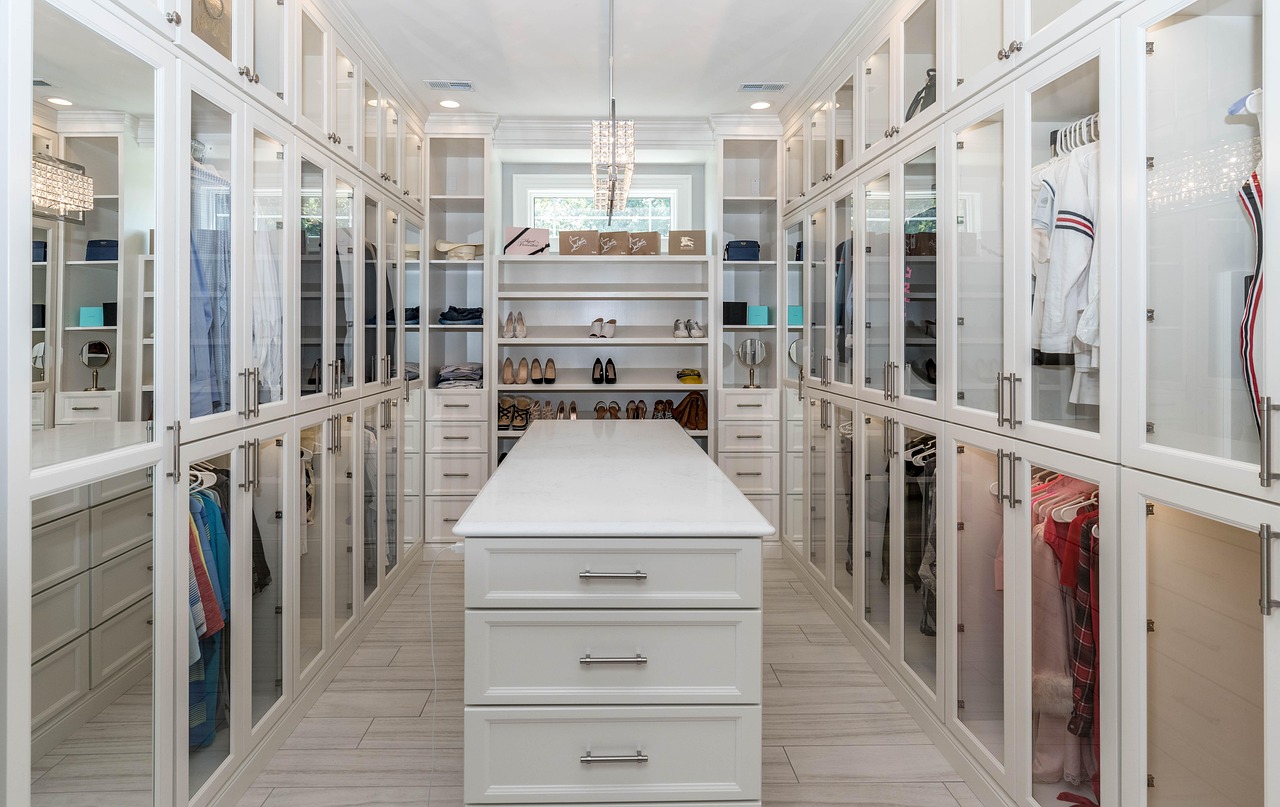
Consider pairing a lighter countertop with a darker base for contrast, or go monochromatic for a seamless look. Your choice should match how much wear and tear the island will actually see.

Storage Features to Prioritize on Your Island
The whole point of an island is better storage. Here’s what actually makes a difference.
- Deep drawers for sweaters and bulkier items. These are more useful than shallow organizers for most people. Aim for at least 8 inches in depth.
- Divided compartments for accessories. Belts, ties, scarves, and sunglasses need their own spots. Look for drawer inserts or built-in dividers. Travelers who need to keep accessories organized on the go may appreciate a set of drawer organizer inserts that fit neatly inside a closet island.
- Pull-out trays for jewelry. A tray with velvet or microfiber lining keeps things organized and prevents tangling.
- Side cabinets for shoes. If your island has space on the ends, cabinets can hold shoes you rotate seasonally.
- Open shelves for baskets. Great for items you want easy access to but don’t need to display — workout gear, bags, or linens.
A common mistake is filling every inch of the island with storage so there’s no clear counter space left. Reserve at least enough room on top to set down a folded shirt or handbag. The balance matters more than maximizing drawer count.
Island Lighting: Task and Ambiance Combined
Good lighting turns an island from a piece of furniture into a functional workspace. You need enough light to see what you’re doing, but you also want the space to feel warm and intentional.
Pendant lights are the most popular choice. Hang them 30 to 36 inches above the countertop for the best task lighting. For a closet, choose pendants with a clean, simple design that doesn’t compete with the rest of the room. Avoid anything too ornate or oversized.
Recessed lighting works well if pendants aren’t your style or if the ceiling is low. Place them evenly over the island area for broad, even illumination.
Under-counter LEDs are a nice addition if your island has an overhang or a raised section. They add task light for detail work like matching socks or checking watch straps. For longer trips, carrying a portable LED closet light strip can provide extra illumination where built-in lights don’t reach.
For bulb color temperature, stick to 3000K to 4000K. This range gives you true color rendering without feeling too cold or too yellow. Dimmers give you flexibility — bright for morning dressing, dim for a relaxed evening routine.
Common Mistakes to Avoid When Designing a Closet Island
Even experienced homeowners make these errors. Avoid them and your island will actually work the way you envisioned.
- Choosing too large an island. This is the most common mistake. You need at least 3 to 4 feet of clearance on all sides. If you can’t walk around the island without shuffling sideways, it’s too big.
- Forgetting about drawer and door clearances. Make sure every drawer can open fully without hitting a wall, another piece of furniture, or the closet door. Measure twice.
- Picking a material that scratches easily. Glass and glossy lacquer look beautiful but show every mark. If your closet sees daily use, choose something more forgiving.
- Ignoring electrical outlets. An island is a great place to plug in a phone, jewelry cleaner, or steamer. Install at least one outlet on the side or in a pop-up unit on the counter.
- Not anchoring a freestanding island. A heavy island on casters can roll if bumped. If you have kids or pets, lock the casters or secure the island to the floor.
Built-In vs. Freestanding Islands: Which Is Right for You?
This decision comes down to permanence, budget, and flexibility.
Built-in islands are permanently installed, often built on site with the same cabinetry as the rest of the closet. They offer maximum storage because every inch is designed around your needs. They can include integrated lighting, electrical pop-ups, and custom drawer configurations. The cost is higher — often several thousand dollars — and you can’t take them with you if you move. They’re best for homeowners who plan to stay in their home for the long term and want a fully custom space.

Freestanding islands are separate pieces of furniture that you place in the closet. They’re considerably cheaper, portable, and easy to replace or update if your style changes. The downside is that they typically offer less storage — less drawer space, fewer compartments, and no built-in power. Some high-end freestanding islands come close to the functionality of built-ins, but you pay a premium for that.
Best for: Built-ins are for custom long-term spaces. Freestanding islands are for renters, shorter stays, or anyone who likes to rearrange their space. If you’re unsure, start with a freestanding island and upgrade later.
Small Walk-In Closet Islands: Making It Work in Tight Spaces
Not every closet is massive, but even a small space can benefit from an island if you choose wisely.
The key is to think narrower and lighter. A slim rolling cart — 12 to 18 inches wide — can serve as a mobile island. Use the top for folding or staging, and fill the shelves below with baskets or organizers. A small wood block on casters works similarly.
Another option is a console table. These are typically long and shallow, so they fit in narrow closets without blocking traffic. Place baskets underneath for hidden storage. Keep the height around 30 to 32 inches so the island doesn’t visually overwhelm the room.
If you have an odd-shaped closet, consider a corner pendant-style table that fits neatly into a nook. The key is to prioritize function over size. A small island that leaves you room to move is better than a larger one that makes the closet feel cramped.

Must-Have Accessories for Your Closet Island
The right accessories make an island more useful without adding clutter. Here are items that solve real problems.
- Valet hooks. A simple hook on the end of the island gives you a place to hang tomorrow’s outfit or a bag. Keeps things off the floor.
- Mirrored tray. A tray on the counter holds cologne, watches, or cufflinks. It keeps small items from rolling away and adds a polished look.
- Jewelry organizers. A drawer insert with padded slots or a velvet tray keeps necklaces from tangling. Look for something with adjustable dividers. Frequent users may benefit from a jewelry organizer drawer insert to keep delicate pieces in place.
- Pull-out hamper. A basket or bin built into the island’s cabinet is a game-changer. No more carrying dirty clothes across the room.
- Decorative storage boxes. These hide items you don’t want on display, like spare buttons or travel chargers. They also add texture and visual interest.
For each of these, there’s a budget-friendly alternative. Instead of a custom valet hook, try a simple adhesive hook. Instead of a luxury jewelry tray, a felt-lined canvas pouch works just as well for organization.
Planning Your Island: Measurements, Clearances, and Layout
Before you buy or build anything, take the time to plan the layout. This is the step where most people make mistakes, and it’s the easiest to get right if you measure carefully.
You need a minimum of 3 feet of clearance on all sides of the island — 4 feet is better. This ensures you can open drawers and walk past without feeling squeezed. If your closet has sliding doors, factor in the door track width so the doors don’t hit the island.
Typical island dimensions are 4 to 6 feet long and 2 to 3 feet deep. For a small closet, aim for 4 feet long and 2 feet deep. For large closets, 6 feet long gives you more counter space and storage.
Think about where the island sits relative to the closet entry. You want people to be able to walk in without immediately hitting the island. Also consider door swing directions — if a door opens into the island, it will block access.
Finally, consider traffic flow. The island should be an anchor, not an obstacle. Map out how you naturally move through the closet and place the island so it doesn’t interrupt that flow.
Final Thoughts: Choosing the Perfect Island for Your Closet
Adding an island to your walk-in closet is one of the most effective ways to improve both storage and daily function. It gives you a dedicated surface, organizes your essentials, and creates a space that feels intentional rather than just a place to hang clothes.
The best island is the one that fits your space, matches your storage needs, and suits your personal style. Measure your closet, think about what you use most, and choose an island that supports your routine. Whether you go for a sleek marble top or a warm wood table, start designing your dream closet island today.