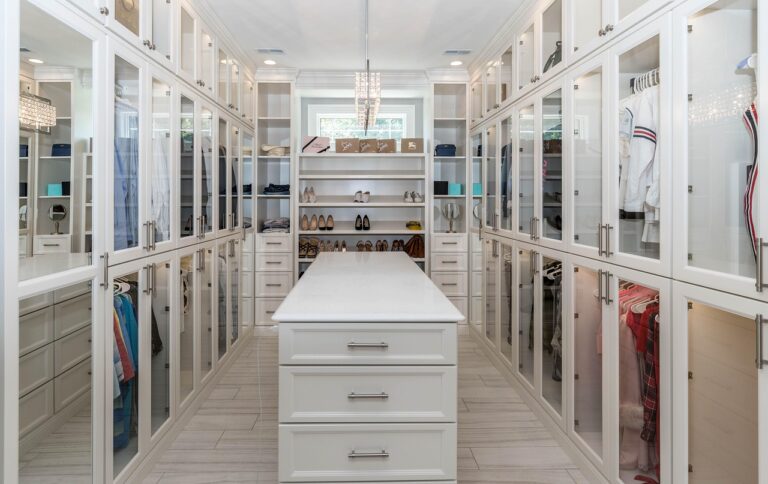
Walk-In Closet Ideas for Men: Tailored and Tech-Heavy
Why Men’s Closets Need a Different Approach

Most walk-in closet advice plays it neutral. It leans toward things that work for delicate fabrics and lighter wardrobes. Suits, sport coats, and heavy denim have different needs. A standard closet setup with uniform hanging height and generic shelving actually works against a wardrobe built on structure and weight.
Take suit jackets. They need at least 42 inches of vertical clearance so the hem doesn’t drag or bunch. A lot of off-the-shelf systems use 36-inch zones. That forces jackets to fold over themselves, which leads to creasing in the shoulders. The same goes for overcoats, trench coats, or anything heavily constructed. You need dedicated long-hanging sections, not flexible rods that end up holding shirts.
Shelving depth is another thing. Most systems default to 16 or 18-inch deep shelves. That works okay for sweaters and bulky knitwear, but for folded dress shirts or neatly stacked henleys, those shelves waste space. You end up stacking two rows deep and lose track of what’s in the back. Shallow shelves around 12 inches deep solve this. You can reach everything, and nothing gets buried.
Drawer strength often gets overlooked. Drawers for watches, belts, or cufflinks can be small and light. But the ones holding jeans or heavy cotton tees need heavy-duty slides and solid construction. I’ve seen standard particle-board drawer bottoms strip out in under a year because someone loaded them with raw denim. You want full-extension ball-bearing slides for anything storing heavy clothing. That’s not an upgrade, it’s a necessity.
The bottom line: designing for a men’s wardrobe means making deliberate choices about height, depth, and weight. Match the storage type to the garment’s needs, not the system’s convenience.

The Core Zones: Hanging, Shelving, and Drawers
Every effective closet revolves around three core zones. Getting the balance right is the difference between a closet that works daily and one that looks great but frustrates you every morning.
Hanging Space: Double vs. Long
Double hanging (two rods stacked roughly 40 inches each) is optimal for pants and dress shirts. That’s the standard setup. One rod for button-downs, one for trousers. It maximizes vertical space and keeps both categories visible.
But you also need at least 36 to 48 inches of long hanging for coats, suits, and robes. A common mistake is trying to make double hanging work for everything, leaving overcoats draped awkwardly across the top rod. Plan your long hanging section near the entry so you can grab a jacket without disrupting the rest.
Shelving: Shallow Over Deep
Shallow shelves (12 inches depth) win for folded items. Use them for sweaters, knitwear, and t-shirts. Reserve deeper shelves for bulky storage like off-season bedding or luggage.
The mistake here is uniform shelving depth. A row of deep shelves quickly turns into a black hole of clothes you forgot you owned. Mix depths. Use adjustable brackets so you can reconfigure as your wardrobe changes. For those implementing this, a set of adjustable closet shelf brackets can make it simpler.
Drawers: Heavy-Duty and Purpose-Built
Drawers are for items that don’t hang well: underwear, socks, gym clothes, jeans, and casual pants. At least one deep drawer for bottoms and one shallower for everything else.
Look for drawers with a weight rating of 75 pounds or more. Many pre-built systems use light-duty hardware rated for 35-50 pounds, which will fail under a full load of denim. Full-extension drawers are non-negotiable for anything deeper than 12 inches. You need to see the back.
Tailored Storage for Accessories: Watches, Ties, and Belts
How you store accessories reveals how serious your organization really is. A pile of belts on a shelf defeats the purpose of a walk-in. Watches rattling around in a drawer is the same.
Valet Trays
A valet tray on your dresser or countertop is the simplest upgrade you can make. It catches the daily carry: watch, wallet, keys, pocket knife, sunglasses. It becomes a routine anchor. You always know where your EDC is. Leather-lined trays look great and prevent scratching. Bamboo options are cheaper and durable.
Watch Storage
If you own more than two automatic watches, skip the single watch box. Go for a humidity-controlled watch winder case with individual slots. Fluctuating humidity is hard on leather straps and delicate movements. A sealed case with a mild desiccant pack or active control extends both strap life and accuracy.
For non-automatic watches, a simple stand or drawer insert with cutouts works fine. What doesn’t work is a tangled pile in a box.
Tie and Belt Racks
Tie racks work best when mounted inside a closet door or on a side panel. Avoid the spinning carousel towers — they crease ties and look cluttered. Flat pull-out racks or simple peg-style hangars keep ties accessible without overcrowding.
Belts deserve the same. Roll them loosely and store in a divided drawer insert, or hang them on a dedicated rack. Avoid hanging belts over a rod that also holds pants. It adds visual noise and makes grabbing one harder than it should be.
Smart Lighting: Beyond a Single Fixture
One central ceiling light is the cheapest way to light a closet, and also the worst. It creates shadows where you need light the most: on shirt sleeves, inside drawers, and across shoes. Good lighting helps you see colors correctly and makes the space feel intentional.
Task Lighting for Shelves
LED strip lights along the front edge of each shelf are the standard upgrade. They eliminate shadows and let you see exactly what you’re grabbing. Look for adjustable color temperature. Daylight (around 5000K) is better for matching colors in the morning. Warmer (around 3000K) is nicer if you use the closet to wind down. For a simple install, consider LED closet strip lighting kits with adhesive backing.
Accent Lighting for Display
If you display watches, shoes, or collectibles, accent lights draw attention without overpowering. Small adjustable spotlights (LED puck lights) aimed at specific items work well. Integrated LED strips inside glass cabinets create a showcase effect.
Smart Controls
Smart bulbs or switches let you control brightness and color temperature from your phone or a voice assistant. The practical benefit isn’t convenience, it’s dimming the lights when someone is still sleeping. A simple motion sensor with delayed off also solves the “lights on all day” problem.
Avoid warm white fixtures exclusively. They distort color for fabrics. Go with adjustable white or daylight fixtures for primary task areas.

Integrating Tech: Charging Stations, Smart Hangers, and More
A tailored closet should accommodate your devices, not pretend they don’t exist. Your phone, watch, tablet, and earbuds all need a home. And a few smart accessories can reduce the mental overhead of managing your wardrobe.
Hidden Charging Drawers
Designate a shallow drawer near the entry as a charging station. Drill a grommet in the back, route a power strip inside, and let it live there permanently. Your phone goes in at night, your watch goes on a wireless charger pad. In the morning, grab everything fully charged without looking at wires. This small detail changes your morning routine.
Use a USB-C power strip to future-proof for phones and laptops. Standard USB-A strips are becoming obsolete. Don’t install one unless you plan to replace it within two years.
Smart Hangers
Smart hangers track how long a garment has been worn and send reminders for dry cleaning. Essential? No. But if you lose track of what needs laundering, they solve a real problem. Most work with an app and use a simple counter inside the hook. Not a gimmick if you genuinely can’t remember if that shirt is fresh or week-old.
Motorized Tie and Belt Racks
A motorized rack is a luxury, but for heavy tie collections it solves the visibility problem. Press a button, the rack rotates, and you see all your options. They require electrical installation and some ceiling reinforcement, so plan early. Not a weekend DIY unless you’re comfortable with wiring.
Climate Control Sensors
A simple humidity sensor and a small dehumidifier or fan protect delicate fabrics from mold and mildew. Leather shoes, suits, and wool coats suffer in persistent humidity. A sensor that alerts your phone or activates a fan automatically is cheap insurance. Especially smart if your closet lacks ventilation.
Shoe Storage: Display vs. Concealment
Your shoe collection probably falls into two categories: daily beaters and special occasion. How you store each matters equally. But the philosophy is personal.
Open Display for Sneakerheads
If you collect sneakers, show them off. Open cubbies or angled shelves visible from the entrance create a showcase wall. The trick is spacing. Sneakers need 8 inches of height per shelf. Boots need 12 to 14 inches. Leave 3-4 inches of depth behind each pair for air circulation. Storing sneakers flat on their soles works for casual wear. For rarer pairs in boxes, use clear acrylic risers so you can see them without opening the box.
Concealed Cabinets for Dress Shoes
Dress shoes benefit from closed cabinets, especially in dusty or humid climates. A pull-out rack or tilt-out bin system keeps pairs together and prevents scratches. Shoe trees are non-negotiable for leather shoes. Insert them when you take the shoes off. If you don’t use shoe trees, you’re slowly destroying the shape.
If you have space, store boots upright using boot shapers. Let them air inside a cloth bag if they’re damp. Never store leather in plastic or airtight bins. Leather needs to breathe.
Common mistake: assuming all shoes fit in a standard 14-inch cubby. Measure your largest pair (usually boots or size 14+ sneakers) before designing the shoe section. Then add 2 inches.
The Island: A Game-Changing Work Surface
A center island turns a walk-in from storage into a functional dressing space. It gives you a surface for folding laundry, packing for trips, staging outfits, or setting down your phone while you get dressed.
Minimum Dimensions and Placement
You need at least 3 feet of clearance on all sides for comfortable movement. Any tighter and you’ll feel cramped. If your room is less than 8 feet wide, skip the island. You’ll hate bumping into it every morning.
The ideal height for standing work is 36 to 38 inches. Counter-height seating is optional, but only if you have clearance to sit without blocking drawers behind you.
Drawer Configuration
An island shouldn’t be a second dresser. It should hold items you access while standing: watches, cufflinks, ties, sunglasses, passport, travel documents. Use shallow top drawers for these. Reserve deeper drawers for items you fold there before moving to their permanent home.
If you include a surface-level glass display case for watches, integrate a charging pad underneath. It keeps the surface clean and your watch charged.
Material for the Top
Solid wood or butcher block works best for the top. Avoid polished stone; it’s cold, expensive, and shows every fingerprint from handling clothes. Granite is okay if you’re set on it, but butcher block is warmer, quieter, and easier to replace if damaged. Marble is too soft and stains easily from leather oils.
Common mistake: installing an island deeper than 24 inches, which forces you to reach uncomfortably for back drawers. Keep it practical.
Material Choices That Hold Up Over Time
Material quality determines whether your closet looks good for five years or five months. You don’t need to buy the most expensive option, but know the tradeoffs.
Shelves and Drawers
- Solid wood (oak, maple, birch): Best durability, can be refinished, supports heavy loads. Expensive and requires maintenance. Worth it for the long haul.
- MDF (medium-density fiberboard): Cheaper, stable, paintable. Lower weight capacity. Avoid for deep drawers holding heavy items.
- Melamine: MDF with a plastic laminate coating. Durable, water-resistant, easy to clean. Scratches can show the base material. Good middle-ground.
- Wire shelving: Cheapest. Excellent ventilation, but wires sag under heavy loads. Not recommended for primary hanging zones. Acceptable for utility shelves.
Rods and Hardware
Standard 1-inch diameter rods are fine for shirts. For suits and coats, upgrade to 1.25 or 1.5-inch to prevent sagging. Double-rod brackets reinforce the connection. Heavy-duty rods from brands like Rev-A-Shelf or Richelieu hold up to 200 pounds per section. Don’t cheap out here. A collapsed rod is a disaster. When shopping, look for heavy duty closet rod options that match your span.

Closet Organization Systems: Prefab vs. Custom vs. Semi-Custom
Prefab Wire Systems
What it is: pre-cut wire shelving and brackets (ClosetMaid, for instance).
Cost: $200-$800 depending on closet size.
Installation: DIY with a drill. Easy to adjust later.
Best for: Utility closets, budget upgrades, temporary solutions. Not recommended for suit-heavy wardrobes due to wire sag.
Semi-Custom Modulars
What it is: modular panels (painted MDF, melamine) you assemble and configure. Common brands: IKEA PAX, EasyClosets, Closets by Design online-only lines.
Cost: $1,500-$5,000.
Installation: Moderate difficulty. Requires leveling and connector hardware. Many brands offer pro installation.
Best for: Homeowners wanting a finished look without full custom pricing. Good for suiting if you choose solid shelving and heavy-duty rods.
Full Custom
What it is: designed and built to your exact measurements by a local carpenter or closet company. Materials are solid wood or premium plywood.
Cost: $8,000-$30,000+.
Installation: Professional.
Best for: Irregularly shaped closets, luxury homes, or specific layout needs (island, motorized racks, display cabinets).
The decision comes down to time and budget. If you have more time than money, semi-custom is the sweet spot. If you want turnkey perfection and have the budget, go custom. Prefab is only acceptable if you plan to replace it in 3-5 years.

Common Mistakes When Designing a Men’s Closet
- Underestimating hanging length for suits. Assume all suits need 42 inches minimum. Many systems default to 36, forcing shoulder bunching.
- Forgetting belt and tie access. Tie racks mounted on the inner side of a cabinet door or a pull-out drawer work well. A hanging rack that spins doesn’t.
- Leaving no space for in-season rotation. You need an empty zone for seasonal garments you’re about to wear. Stuffing them in a drawer defeats the purpose.
- Ignoring ventilation for shoes. Closed cabinets for footwear need venting. Without it, leather and fabrics can develop mildew. A cheap grille on the door or a low-volume dehumidifier fixes this.
- Designing from Pinterest rather than your wardrobe. Measure your longest coat, thickest sweater, widest shoulders. Then design the layout. Trends don’t matter if nothing fits.
Avoid these, and you’re ahead of most first-time builders.
Cost Breakdown: What to Expect for a Tailored, Tech-Heavy Closet
The budget varies widely depending on scope. This is a realistic breakdown .
Basic Upgrade ($500-$2,000)
This buys a prefab wire system, basic LED lighting (battery strips or plug-in on a smart switch), and one or two valet trays. No island. No smart integration. Acceptable for utility but limited in tailoring.
Mid-Range ($3,000-$8,000)
This gets a semi-custom modular system (IKEA PAX or EasyClosets). Solid wood or melamine shelving. Heavy-duty rods for suiting. LED strip lighting throughout. A small island if the room allows. Basic watch winder. A charging drawer. This is the sweet spot for most homeowners.
Luxury Custom ($10,000+)
Full custom build with solid wood. Dedicated shoe and accessory display. Motorized tie rack. Climate-controlled watch vault. Hidden charging drawers. Smart lighting with full automation. Professional installation. For the person who wants no compromises.
Where the Money Goes
- Shelving system: 40-50% of total
- Lighting: 15-20%
- Hardware: 10-15%
- Accessories (valet trays, watch winder, smart hangers): 10%
- Labor (if pro): 15-25%
A well-designed closet adds value to your home and daily life. It’s one of the few renovations that pays dividends in convenience.
Final Checklist: Must-Haves Before You Build
Before you open a shopping cart or call a contractor, run through this list.
- Measure everything. Longest coat, tallest boot, widest shoes. Build around your wardrobe, not the other way.
- Define each zone. Decide where suits live, where t-shirts fold, where shoes go. Every item needs a home.
- Choose lighting early. Run wiring or decide on battery versus plug-in before shelving is installed.
- Commit to the island (or not). It changes the layout completely. Decide before you finalize perimeter storage.
- Lock in accessory storage. Know exactly how you’ll store watches, ties, belts, and shoes. Don’t leave them as an afterthought.
- Set a tech budget. Include charging drawers, smart hangers, and climate sensors if they matter to you. Skip them if they don’t.
A tailored, tech-heavy walk-in closet isn’t about showing off. It’s about removing friction from your daily routine. When you wake up, get dressed, and start your day without struggling to find a matching belt or locate your watch, that’s the real win. Start designing your dream setup today — your morning routine will thank you.